Have you ever bought a greeting card because it had a great sentiment, but you didn't know what to write in it to make it more personal? You are not alone.
When giving a card, you want to make the recipient feel special, and to honor your connection with them. So how can you do that? We'd love to help.
Since Easter is coming up soon, this post will focus on what to write in your Easter cards. We will have other blog posts soon that will focus on card writing tips for other holidays and birthdays.
Here are the important steps we recommend for writing a good sentiment in an Easter card.
We will first give you an overview, followed by a more detailed explanation for each idea.
For Easter cards, you will want to begin by writing the person's name inside (or names if it is going to a family or couple). This may seem obvious, but some people skip ths step. Writing names is an important part of being personable with the card. Names should always be written out inside the card!
Here are some examples:
Next, you will include your Easter wishes for them, such as an extra bright and happy Easter with family. Or how you hope their day is filled with faith and joy. (Try to not repeat what is already pre-printed in the card.) Follow our ideas below as a basic guideline, adapting it to the people you are sending the card to:
OR something like this:
Include a personal thought that celebrates a special connection you have with them:
A Christian Easter card should include a faith-based celebration of the resurrection:
Close with a blessing:
Sign your name (names of people in your family).
Proof-read the card and the address on the envelope.
Fun tip: Add stickers, washi tape, or use colorful ink to make it more special, when possible.
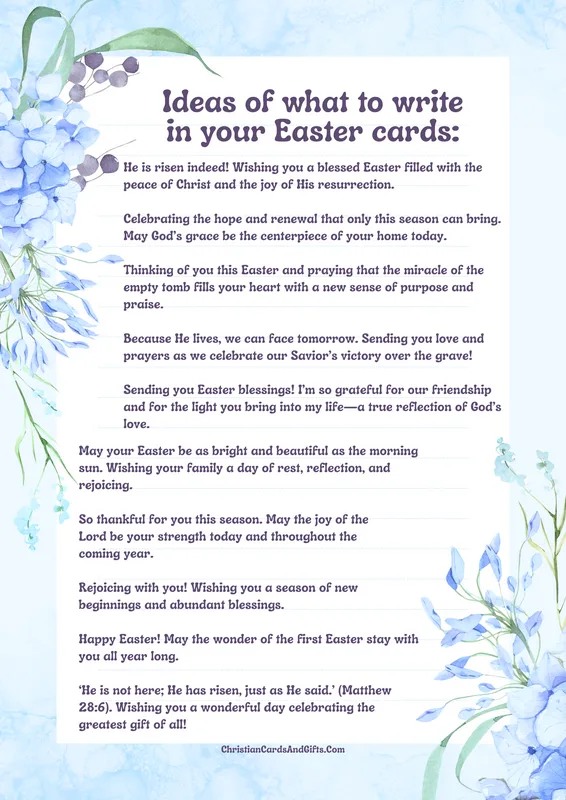
In the image below you will find some ideas of great sentences to include in your Easter cards this year!
When giving a card, you want to make the recipient feel special, and to honor your connection with them. So how can you do that? We'd love to help.
Since Easter is coming up soon, this post will focus on what to write in your Easter cards. We will have other blog posts soon that will focus on card writing tips for other holidays and birthdays.
Here are the important steps we recommend for writing a good sentiment in an Easter card.
We will first give you an overview, followed by a more detailed explanation for each idea.
- Write out all of the names of the people included in your Easter wishes.
- Read the card's pre-written sentiment thoroughly so you don't repeat what it already says.
- Include Easter wishes (who, what, when, where, why, how).
- Tie in a heartfelt memory or connection you have with them.
- Incorporate a faith-based message, to celebrate the resurrection.
- Close with a blessing.
- Sign the names of everyone the card is from.
- Proof-read the card and the addressed envelope.
For Easter cards, you will want to begin by writing the person's name inside (or names if it is going to a family or couple). This may seem obvious, but some people skip ths step. Writing names is an important part of being personable with the card. Names should always be written out inside the card!
Here are some examples:
- Dear Jane and Paul,
- Dearest Smith Family,
- To Our Wonderful Neighbors, the Hansons
- For My Loving Sister, Gloria
- Dear Sue, Dan, Michael, Julie, and Emily
Next, you will include your Easter wishes for them, such as an extra bright and happy Easter with family. Or how you hope their day is filled with faith and joy. (Try to not repeat what is already pre-printed in the card.) Follow our ideas below as a basic guideline, adapting it to the people you are sending the card to:
- Who - Wishing your family....
- What - a wonderful, joyous, and blessed...
- When - Easter Sunday...
- Where - at church...
- Why - to celebrate the risen Savior...
- How - together.
OR something like this:
- This year at Easter, hoping you reflect on great memories with your loved ones who mean so much.
Include a personal thought that celebrates a special connection you have with them:
- I've always loved our Easter dinners together through the years.
- Thank you for being a special part of my life. I treasure our friendship.
- I'm so thankful to have you as my sister. What a blessing you are to me!
- I often think of our childhood school days together, and am thankful for our longtime friendship.
- I wish I could see you more often. Please know that I think of you with gratitude every day.
A Christian Easter card should include a faith-based celebration of the resurrection:
- Rejoice in the hope we have because of our risen Savior!
- He is risen, and we are so thankful!
- May the love of Jesus fill your heart with hope and joy!
- May the peace and hope of Christ be yours all through the year!
- Add a Bible verse about the resurrection.
- John 3:16
- Romans 8:11
- Matthew 28:6
Close with a blessing:
- God bless you!
- Have a blessed Easter!
- Praying for you,
- Love and prayers,
Sign your name (names of people in your family).
Proof-read the card and the address on the envelope.
Fun tip: Add stickers, washi tape, or use colorful ink to make it more special, when possible.
In the image below you will find some ideas of great sentences to include in your Easter cards this year!
We have CHRISTIAN Easter cards available for sale here: EASTER